The 1828 Apothecary Story Behind Hokus Pokus
In 1828, a Scottish pill-seller named James Morison opened the British College of Health on the New Road, just a few doors from where The Megaro stands today. It wasn’t a college, and by modern standards it had very little to do with health, but it made Morison famous across Britain and beyond. Nearly two centuries later, his story is the reason our underground bar is called Hokus Pokus, and the reason it looks like a Victorian apothecary.
Who was James Morison?
Morison came to medicine late, and from business rather than training. He was born at Bognie in Aberdeenshire in 1770, studied at Aberdeen University and in Germany, and spent his early career as a merchant, first in Riga and then in the West Indies. Poor health brought him back to Europe, and by his own account he spent 35 years trying every treatment going before curing himself around 1822 with a few vegetable pills of his own making, taken at bedtime with a glass of lemonade in the morning.
He was convinced enough to make a business of it. In 1825 he began selling his “vegetable universal medicines”, better known as Morison’s Pills, and he gave himself a title to match: “the Hygeist”. The main ingredient is said to have been gamboge.
The British College of Health on the New Road
In 1828, in partnership with Thomas Moat, a merchant from Devon, Morison put up a large building at Hamilton Place on the New Road and called it the British College of Health. The name did a lot of work. In practice it was an establishment for selling Morison’s Pills, and the grand title was part of the sales pitch.
What it sold was a whole philosophy. Morison called it Hygeism, and its central idea was that disease came from impurities in the body, so the cure was to drain them out. His advertising leaned on a memorable image. One broadside from the 1830s, now held by the Wellcome Collection, shows the Hygeists tending a healthy tree with the College in the background, beside a second scene of physicians hacking at a sickly tree branch by branch. Conventional doctors, in other words, were the problem, and a box of vegetable pills was the answer.
It was a confident message, and it sold. The pills became especially popular in the west of England, and the College became the centre of an operation that reached well beyond London.
Fame, ridicule and a fortune in medicine stamps
Morison’s Pills were everywhere enough to become a joke. Thomas Carlyle made repeated scornful references to them in his book Past and Present, and in Robert Wilkie’s 1840 farce Yalla Gaiters the hero is captivated by a countryman singing a ballad in praise of Morison’s “Vegetable Pills”. His own essays, gathered into a volume called Morisoniana, ran to several editions and were translated into a number of European languages, which tells you how far the brand travelled.
The money was real, too. Between 1830 and 1840, Morison paid £60,000 to the government for medicine stamps, and in his later years he lived in Paris, where the profits from French sales alone were said to cover his costs. He died there on 3 May 1840. Today the Science Museum Group files him, plainly, under quack medicine.
How Morison’s story shaped Hokus Pokus
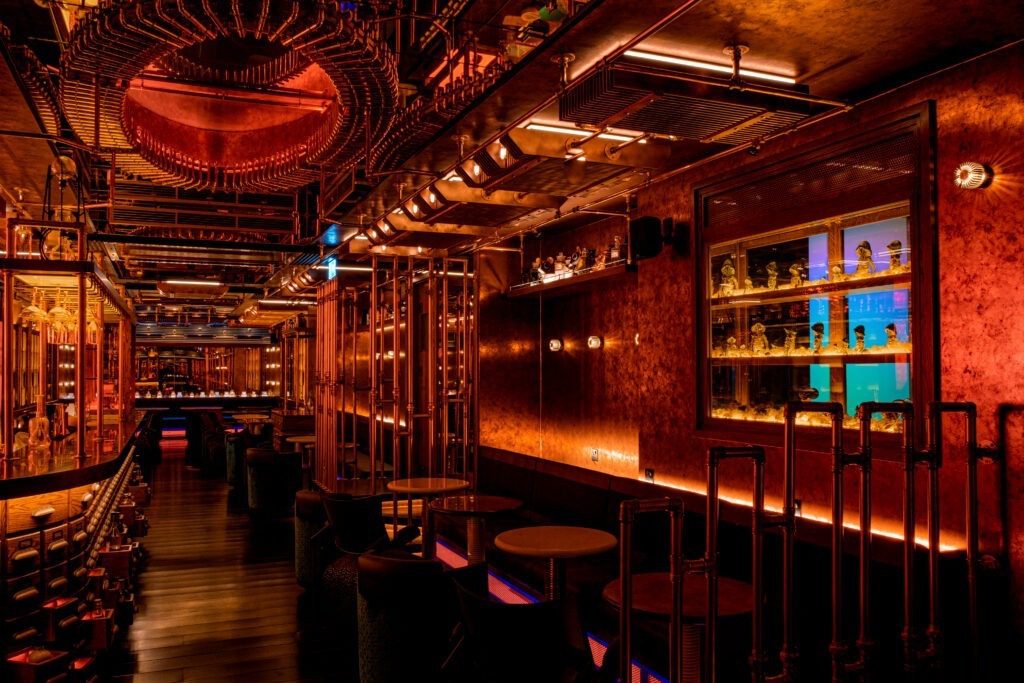
Hokus Pokus takes its name and its design from the 19th-century quack doctors who embraced experimental chemistry and miraculous cures, and Morison is the obvious local hero of that story. The room underneath The Megaro carries the rest: Victorian apothecary details meet a futuristic steampunk edge, so the cabinets of curious equipment feel less like a museum and more like a laboratory that’s still in use.
The drinks pick up the thread, too. Where Morison promised that a box of vegetable pills would cure all ills, our bar serves botanical concoctions, potions and elixirs, with ingredients distilled, infused and prepared in-house. The difference is that we make no claims of health benefits. We’re simply confident that a well-made cocktail might do wonders for your mood.
Raising a glass to the Hygeist
You’ll find Hokus Pokus on the lower ground floor of The Megaro at 1 Belgrove Street, moments from King’s Cross and St Pancras International. You don’t need to be staying with us to visit, and booking ahead is the easiest way to make sure there’s a table waiting. If you’d like to know more about the room and the drinks before you go, our guide to Hokus Pokus covers the cocktail list in more detail.
For a bigger occasion, the bar can be booked for groups, and this Christmas it’s available for semi-private hire for up to 40 guests or exclusive hire for up to 60. You can find the details on our Christmas at Hokus Pokus page.
Fancy a potion of your own? Book a table at Hokus Pokus and raise a glass to the pill-maker down the road. No claims, no cures, just very good cocktails.